The Chemical Your Cashier Handles Hundreds of Times a Day
Thermal receipts are coated in BPA — a hormone disruptor the EU banned in 2020. Saudi stores have no equivalent protection. Here is the evidence.
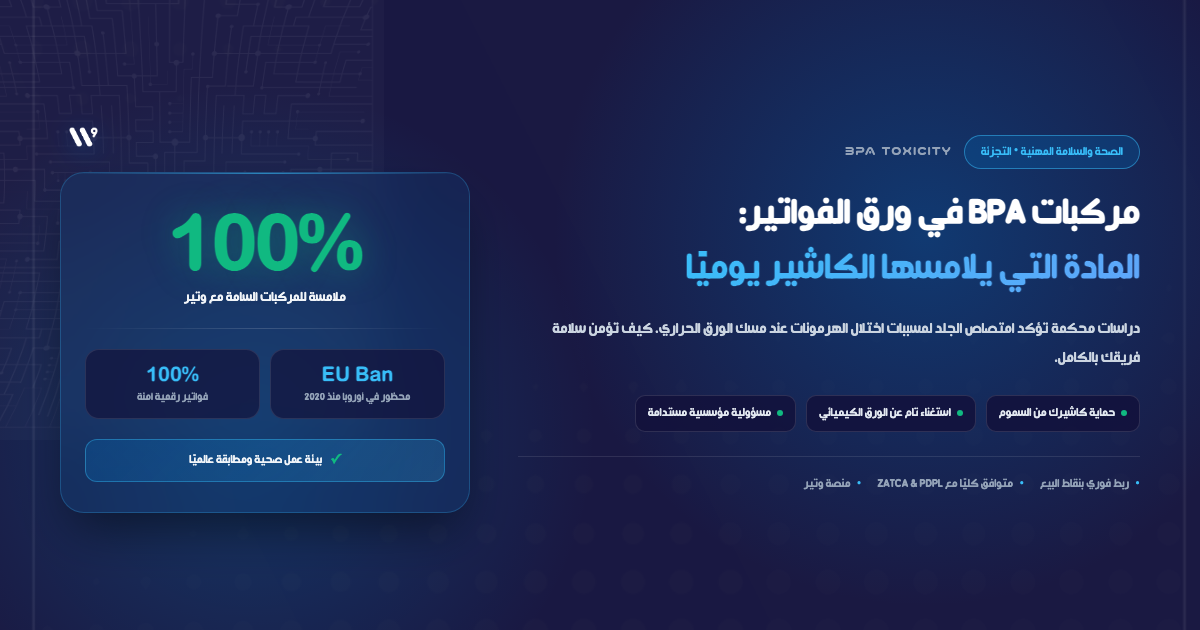
A cashier at a busy cafe handles hundreds of receipts every shift. Each one is coated in Bisphenol A, a chemical the European Union formally restricted in 2020 because it disrupts the human endocrine system. Not in trace amounts. In amounts measurable in blood and urine after a standard workday at a thermal printer.
This is not a fringe risk. It is every lane in your store, every day.
How BPA ends up on skin
Thermal printers do not use ink. The paper carries a heat-reactive coating, historically BPA and now increasingly BPS or BPAF as manufacturers substituted under regulatory pressure. Heat from the printhead activates the coating and the text appears.
That coating sits on the surface of the paper. It is exposed. It transfers.
A 2014 study published in PLOS ONE (Hormann et al.) measured BPA absorption from thermal receipts during normal handling. The finding every food-service operator should know: adding alcohol-based hand sanitizer, standard practice in cafes and quick-service environments, sharply increases dermal BPA absorption. The alcohol acts as a carrier, pulling BPA through the skin barrier faster and in larger quantities than dry-hand contact alone. The daily sequence of handling a receipt, applying sanitizer, then handling another receipt is not neutral. That sequence is the problem.
The regulatory gap
The European Chemicals Agency classified BPA as a Substance of Very High Concern under REACH. Commission Regulation (EU) 2016/2235, effective January 2020, restricted BPA in thermal paper across all EU member states. France moved earlier with a national ban in 2015, five years ahead of the EU-wide rule.
Saudi Arabia has no equivalent restriction.
The thermal rolls in your storeroom carry no BPA disclosure. Your cashiers receive no occupational exposure guidance. The protection that covers a cashier in Paris or Berlin does not extend to a cashier in Riyadh.
The "BPA-free" trap
Switching to BPA-free thermal paper does not solve this. Most BPA-free coatings substitute BPS, and ECHA has flagged BPS as a substance of equivalent concern with similar estrogenic activity across multiple assessment reports. The substitution was regulatory arbitrage, not a safety improvement. The only clean exit is off thermal paper entirely.
The Saudi store pattern
An employee working five days a week at a location processing hundreds of transactions a day handles tens of thousands of receipts a year. Receipts that customers decline still get touched, pulled from the printer, offered, handled twice. Exposure does not require acceptance.
For food and beverage operators running multiple terminals at high daily volumes, the exposure compounds across the entire cashier team. This is the invisible occupational hazard sitting between the point of sale and the customer: unregulated, unreported, and present at every transaction.
What Wateer does instead
Wateer routes every transaction through a digital receipt via WhatsApp, SMS, email, or QR, with no thermal paper anywhere in the chain. Your cashier handles the coffee, not the chemical.
Sources & References
- European Commission — Official Text of Regulation (EU) 2016/2235 Banning BPA in Thermal Receipts
- Peer-Reviewed Study (PLOS ONE / PubMed 25338103) — Elevated Dermal Absorption of BPA from Receipts via Hand Sanitizers
- European Commission — Regulation (EU) 2024/3190 Restricting BPS & Endocrine Disrupting Alternatives
Related reading
Want to see Wateer on your system?
Talk to Sales